

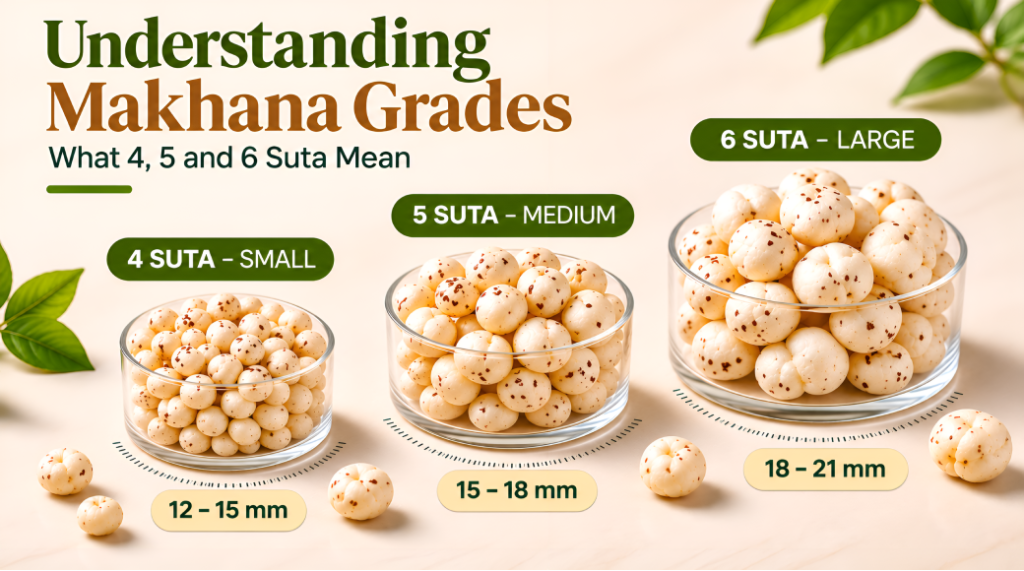
Most online sellers sell makhana (fox nuts) without telling you how big it is. Look at a typical listing: the pack rarely shows the suta (“4 suta”, “5 suta”, “6 suta”), and the page does not say which grade you are buying. Suta is the word the trade uses for the size of a popped makhana kernel, so a seller who leaves it out is leaving out the one number that tells you what is inside the pack. Makhana has had a lot of attention lately: Mithila makhana earned a GI tag in 2022, and Bihar’s makhana has drawn policy interest since. More buyers means more choice, and the buyers who know about suta and grade choose best. This guide explains what suta means, why the numbers you read online do not agree, how to compare packs when a seller will not tell you the grade, and how Avyra Foods does it differently: we tell you the suta and the grade, and our makhana is lab tested at an NABL accredited laboratory.
What does “suta” mean?
Suta (sometimes spelled “sutta”) is a traditional unit that traders use for the size of a popped makhana kernel. The higher the number, the bigger the kernel. Most guides take 1 suta as about 3.17 mm, which lets you turn a suta grade into millimetres. Traders use the word every day, yet most online sellers never print it for the buyer, so most buyers never learn what it means.
Suta grades in millimetres
Here is how the size ranges are commonly quoted. Notice that the sources do not agree with each other, so treat every range as approximate.
| Grade | Commonly quoted size | Other ranges you may see |
|---|---|---|
| 4 suta | about 12–15 mm | 12–14 mm |
| 5 suta | about 15–18 mm | 14–16 mm, 15–19 mm, 15–20 mm |
| 6 suta | about 18–21 mm | 19–22 mm, 19–24 mm |
| 7 suta | above 21 mm | sold as extra large |
Why most online sellers do not tell you the grade
There is no single legal standard for suta. Sellers round differently, and trade grading is based on the sieve size of the seed, so a “mm” range can describe the raw seed or the popped kernel. That makes the suta easy to leave off the pack, and many online sellers do exactly that. They do not print the suta, they do not name the grade, and they give no size in millimetres either. The result is that you cannot check what you are buying, and two packs at two prices may hold very different kernels. A grade you can see, with a size in millimetres next to it, is a clearer promise.
Does a bigger grade mean better makhana?
Not automatically. Size changes how the makhana looks, how it bites and what it costs. Smaller kernels are often used in flavoured snacks; larger ones are chosen for a premium look and a more delicate bite. At least one trade guide notes that the grades are nutritionally much the same: the difference is size, appearance and price. So choose the size for how you plan to use it, and choose a seller who tells you which size you are getting.
How Avyra Foods is transparent about suta and grade
At Avyra Foods we do not leave the grade out. We tell you the size in millimetres and the suta it corresponds to, for every pack, and we send our makhana to an NABL accredited laboratory for testing. NABL is India’s National Accreditation Board for Testing and Calibration Laboratories, which accredits laboratories against the ISO/IEC 17025 standard, so the reports come from a lab that is independently assessed.
- The Classic: medium to large kernels of about 12–19 mm, roughly 4 to 6 suta, whole, round and firm, with a crisp, satisfying bite. Good for roasting, seasoning, recipes and everyday snacking.
- The Jumbo: extra large kernels of about 20–24 mm, roughly 6 to 7½ suta, whole, round and firm, and delicate enough to melt in the mouth. Good for premium snacking, gifting, roasting and special recipes.
The suta figures come from dividing the size in millimetres by 3.17 mm. Suta ranges vary between sources, so the conversion is approximate, which is why we give the millimetres as well: you can check the size yourself.
Both are sourced in Mithila, Bihar, and lab tested at an NABL accredited laboratory. You can open the reports on our Test Reports & Certifications page, and our FSSAI licence number is shown in the site footer.
Five things to check before you buy makhana online
- The suta, the grade and the size in millimetres. If a seller shows none of them, ask, or buy from one that does.
- What the size describes: raw seed or popped kernel.
- The weight of the pack and the price per 100 g. At today’s single-pack prices, our 200 g Classic works out to about ₹150 per 100 g (₹299) and the Jumbo to about ₹185 per 100 g (₹369). Prices can change, so check the pack page.
- Proof of testing, from an accredited lab, and a food licence: a report you can open, issued by an NABL accredited laboratory, and an FSSAI licence number.
- Ingredients and shelf life on the page. Plain makhana should list one ingredient. Ours is 100% makhana (fox nuts), with a shelf life of 12 months.
Not sure which to start with? The Combo Pack has one 200 g Classic and one 200 g Jumbo, so you can compare the sizes yourself.
Sources: suta-to-millimetre conversions and grade ranges compared from Mera Kisan, Hybite Foods, Tirhutwala and Absolute Nuts, read on 2 November 2026. These are trade and seller guides, not an official standard, which is why their ranges differ.